
*LATIN (N. NOM./ACC. PL. OF AEQUOR) — SURFACE OF THE SEA; LEVEL SURFACES

COMMERCIAL ADVISORY FOR COMPLEX PROJECTS
Aequora helps organisations navigate the commercial and contractual challenges of cross-border construction projects. We help clients understand how decisions made before and during project delivery influence outcomes, focusing on solutions that preserve collaboration and momentum while keeping projects resilient, efficient and sustainable.
COMMERCIAL ADVISORY
The way a contract operates in practice can be very different from how it reads on paper. We assess contracts through a commercial lens: how risk allocation, payment terms and contractual mechanisms affect cashflow, working capital and project outcomes, and how processes such as change management function in practice once a project is underway. Where appropriate, cashflow modelling and scenario analysis are used to quantify the potential impact of commercial risks and support informed decision-making. Reviews range from targeted assessments of individual risks to comprehensive evaluations of contracting strategies and are tailored to the specific objectives of each project.
01.
HEALTH CHECK
A focused review of commercial contract terms, cashflow and risk allocation. The assessment highlights key risks, negotiation priorities and project-specific exposures that may affect project delivery and profitability.
02.
DUE DILIGENCE
An independent commercial review to support investment decisions. The assessment considers project assumptions, key parties, supply chain arrangements and contract terms, with a focus on bankability and commercial risk.
03.
SOLUTIONS
Support in implementing actionable mitigation measures for identified commercial and financial risks. Solutions may include contractual protections, financial hedging and specialist support tailored to the project.

FX MATTERS
An EU contractor pricing a £630,000 UK project in early 2022 on the assumption of a GBP/EUR of 1.19 would ultimately have received approximately 3.3% less revenue in euro terms as a result of exchange-rate movements over the project lifecycle. Assuming an 8% project margin, this would have reduced expected profit by approximately 41%. For projects operating on single-digit returns, unmanaged foreign exchange exposure can quickly become a significant commercial risk, making it important to consider currency risk allocation at contract stage.
CONTRACT MANAGEMENT
Contract management is often treated as an administrative process focused on notices, compliance and record-keeping. We take a broader view, extending the commercial advisory approach into project delivery and considering how decisions affect cashflow, risk allocation, stakeholder relationships and overall project performance.
Embedded within project teams on a retainer, secondment or project-specific basis, we provide commercial and contractual support throughout project delivery. From procurement and subcontract strategy to variations, claims and project close-out, recommendations are made with the project's overall commercial health in mind.

NEW RULES
What appeared to be a standard contract contained commercial assumptions that differed from the contractor's usual market practice. On the same £630,000 UK project, a seemingly routine 2.5% retention provision would hold back around €18,000 for up to twelve months. At an 8% margin, that is about one-third of the expected profit, earned but not received until long after the work is done. Together with the exchange-rate exposure, the contractor's margin comes under pressure from two sides.
TRAININGS AND SEMINARS
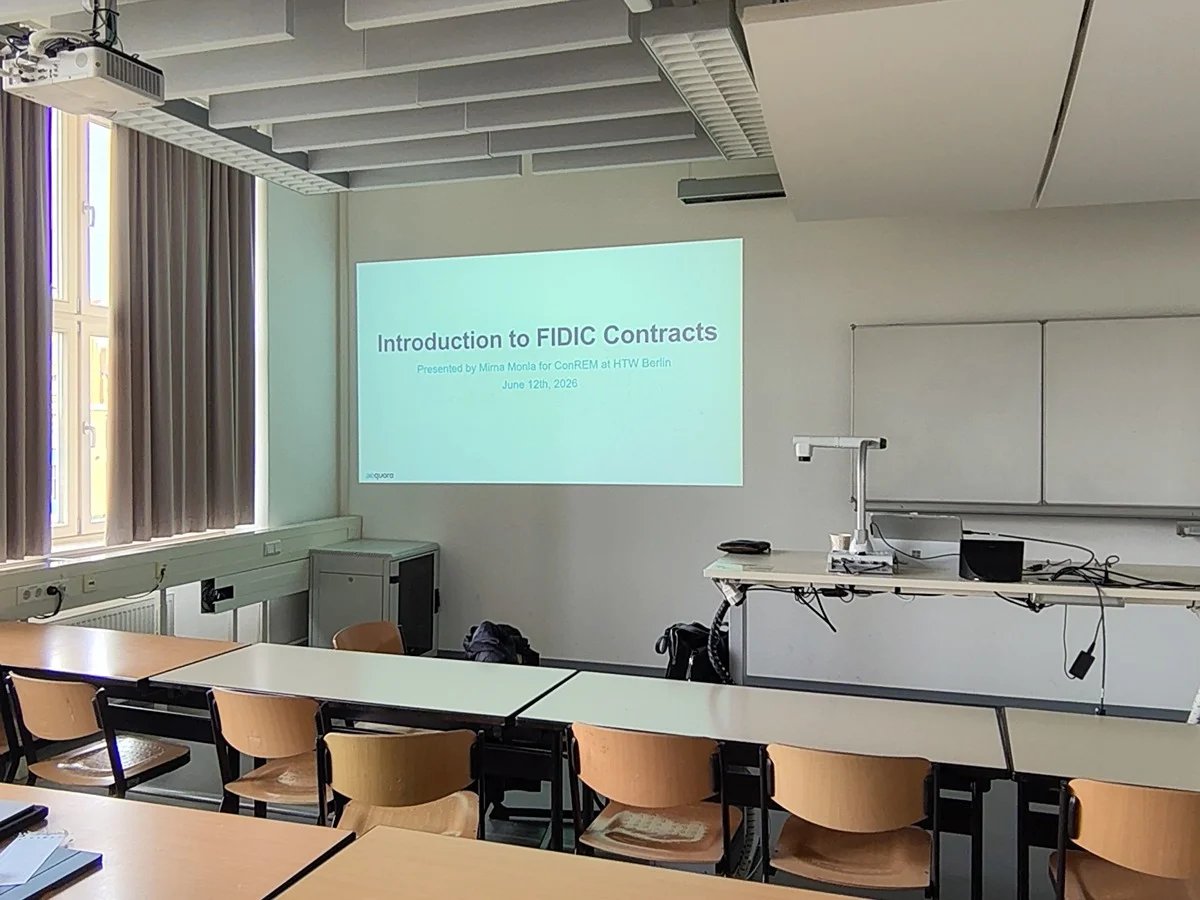
International contracting frameworks are most effective when understood in the context of project delivery. Our training programmes combine international contracting frameworks with practical perspectives on commercial risk, project execution and stakeholder management.
Programmes can be tailored to the needs of individual projects, organisations and professional audiences, covering FIDIC contract management, risk allocation, change management and claims, alongside comparative references to VOB/B practice where appropriate.
MIND THE GAP
Offshore wind projects are often delivered through multiple FIDIC-based contract packages, with key milestones dependent on the performance of several contractors. On one such project, a standard delay damages mechanism worked for neither side: it either exposed the contractor to damages long before any loss could arise, or left the employer with limited room to mitigate. Sharing the timing risk between the parties preserved the incentive to deliver on time without exposing the contractor prematurely.
FOCUS AREAS
We work across sectors characterised by international supply chains, long project durations and cross-border commercial risk. In these environments, project outcomes are increasingly influenced by factors such as foreign exchange exposure, commodity price fluctuations, CBAM requirements and the effectiveness of contractual escalation mechanisms, alongside traditional delivery and performance considerations.
01.
RENEWABLE ENERGY
Supporting renewable energy projects, including offshore wind foundations, turbine supply and related infrastructure works.
02.
MANUFACTURING
Commercial and contract management support for manufacturing, logistics and industrial projects from procurement to delivery.
03.
ENERGY PERFORMANCE
Applying commercial and contractual expertise to energy performance projects, ESCO structures and performance-based models.

ABOUT US
Aequora is led by Mirna Monla, who brings over 17 years of experience in international construction and infrastructure projects, including offshore wind, from project development and procurement through to contract and claims management. Where project requirements call for it, Aequora works with independent specialist firms and experts to provide additional expertise and complementary services.

Mirna Monla
Founder & Managing Director